Tokenomics

Introduction
The Globula ecosystem revolves around its native token, $GLB, which serves multiple critical functions: it is a control and voting token (for future governance), a key instrument for interacting with the game's economy, and the primary game asset for trading and the creation of unique in-game objects. A cornerstone of the in-game economy is the concept that all significant game objects are intrinsically linked to $GLB, effectively being "made" from $GLB tokens and possessing different intrinsic values. This is facilitated through standards like ERC-6551, allowing game items themselves to function almost as wallets or containers for their underlying $GLB value.
The technical philosophy for on-chain components prioritizes blockchain agnosticism and abstraction. This means that while initial builds and integrations occur with specific blockchain technologies (like EVM), the architecture is designed for flexibility. The underlying on-chain stack may evolve, expand, or integrate with multiple chains over time to best serve the needs of the Globula ecosystem and its users, without rigid ties to a single solution.
$GLB Characteristics
Token Utility Summary: The $GLB token functions as a core in-game asset for crafting & item enhancement (its intrinsic value creates a deflationary sink); enables participation in ecosystem value distribution mechanisms fueled by game activity & token buy-backs; facilitates high-value P2P trades & UGC interactions; and is designed for future community governance over in-game elements.
Ticker: GLB
Blockchains: EVM, Aurora, NEAR, TON
Total $GLB Supply: 1,000,000,000
Burning: While direct, continuous burning of $GLB is not a primary protocol feature, specific game mechanics are designed to reduce the circulating supply
Additional emission: NO
Vesting periods: 0-60 months
The following sections detail the core economic mechanics that bring these utilities to life and drive the sustainable "PLAY2BE" vision of Globula
Token Allocations and Distribution

Core Economic Mechanics of the Globula Ecosystem
The "PLAY2BE" model of Globula is powered by a synergistic set of five core economic mechanics. These mechanics are designed to drive user engagement, create sustainable value flows, manage token supply, and reward active participation within the ecosystem.
Mechanic #1: Transactions Share & Ecosystem Funding
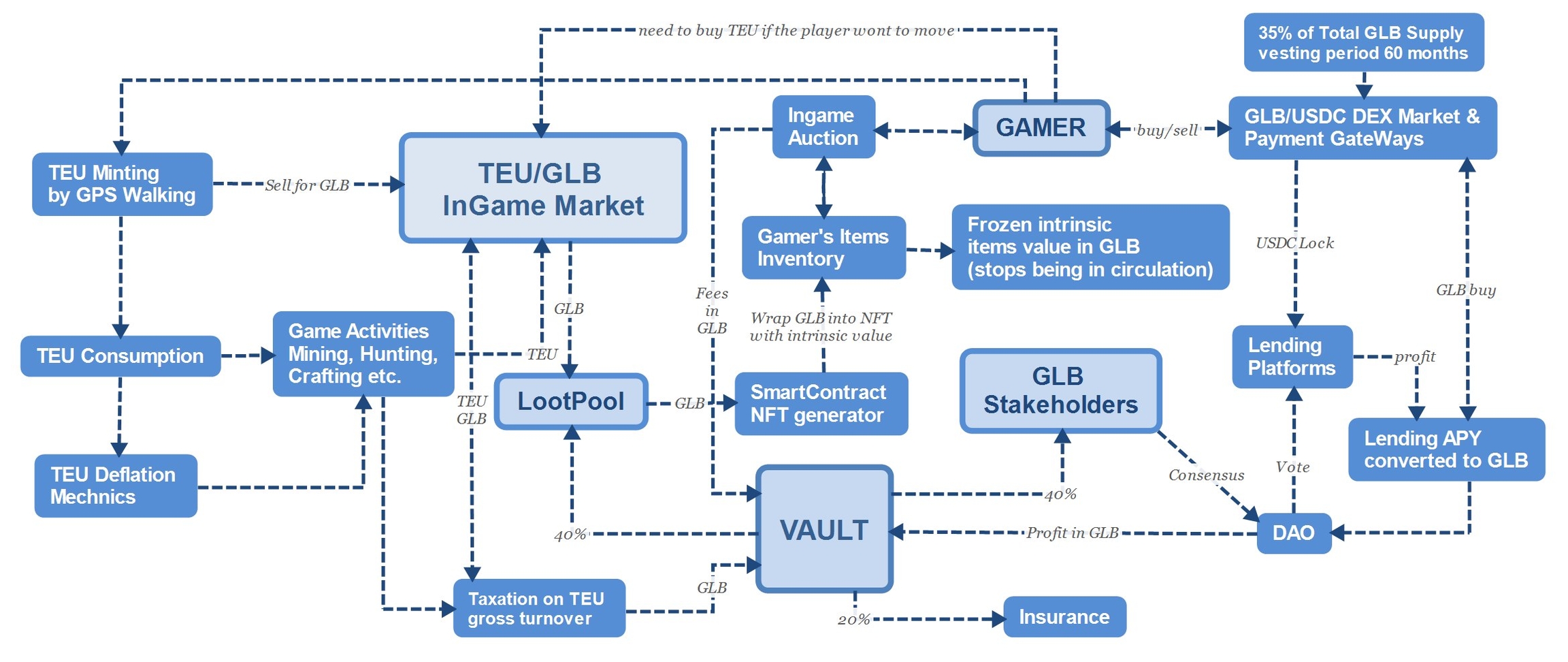
A percentage of value from key in-game economic activities is collected as platform fees. This includes a 2.5% commission on all P2P trades and exchanges, plus a 4% transaction fee on the "energy gross turnover" of player activities. The value generated is strategically allocated:
80% Value Distribution Share: Distributed back to active players and stakeholders, fostering a circular economy and rewarding engagement.
20% Insurance Fund: Directed to a dedicated fund to mitigate technological risks, particularly those associated with potential external project dependencies. This mechanic ensures that a portion of all economic activity directly benefits the participants and the long-term stability of the ecosystem, while also contributing to buy-pressure on the $GLB token.
Mechanic #2: Intrinsic Value & $GLB Wrapping in Game Objects
This mechanic directly imbues in-game items with tangible, underlying value through the $GLB token, creating a system where game assets have both an Intrinsic Value and a Market Value.
Concept: The $GLB token allows for the creation of game objects that essentially "wrap" or contain a specific amount of $GLB. The $GLB coin itself and the game object are inseparable concepts while the item exists in its wrapped form.
Analogy: Imagine making a paper airplane with excellent flight characteristics out of a hundred-dollar bill. The airplane (game object) has functions and parameters, but it fundamentally remains that hundred-dollar bill (Intrinsic Value). If the game item is "unwrapped" or destroyed, the $GLB it contained is returned to its standard token state.
Market Dynamics: The utility, characteristics, parameters, and functions of the game object determine its demand and thus its Market Value, which can be higher than its Intrinsic Value. Players are incentivized not to unwrap items if their Market Value (due to usefulness in the game) exceeds their base $GLB Intrinsic Value.
Economic Impact:
The more in-demand game items created, the more $GLB is "frozen" or locked within these objects.
The more $GLB is frozen in items, the less $GLB is in free circulation.
Reduced free circulation can contribute to upward price pressure on $GLB. All in-game items with intrinsic value are held by the user. This mechanism directly links item creation and utility to $GLB tokenomics.
Mechanic #3: Demurrage Asset System (TEU Resource Management)
Globula utilizes a secondary in-game resource, Temporal Energy Units (TEU), which is subject to a demurrage system.
Principle: TEU is designed to lose a portion of its purchasing power or quantity over time if hoarded. This concept, inspired by Silvio Gesell's theories, incentivizes players to actively spend, trade, or invest their TEU rather than accumulate it indefinitely.
Effect: This promotes a higher velocity of TEU circulation within the game economy, stimulating activity.
Auto-Burn: Additionally, overall game activity (proxied by DAU) contributes to an automatic burn mechanism for TEU, further managing its supply and ensuring it remains a dynamic resource.
Mechanic #4: Programmatic $GLB Buy-Pressure Curve & Dynamic Reward System
This sophisticated engine creates sustained buy-pressure for $GLB and dynamically rewards active players.
Mechanism: A significant portion of the total $GLB supply (35%, vested over 5 years) is autonomously managed by a smart contract. This contract sells these tokens through a price-escalating curve on a DEX.
Yield Generation & Buy-Back: Stablecoins received from these sales are programmatically deployed into selected DeFi protocols (DPOS, DLM) to generate yield. All profits from these DeFi activities are then used to execute buy-backs of $GLB tokens from the open market.
Reward Distribution: The repurchased $GLB is channeled into an in-game "Reward Loot Pool." Players receive portions of this $GLB (often via valuable in-game items with intrinsic value) based on their in-game activity levels and the total intrinsic value of items they actively use. This incentivizes gameplay and engagement.
Mechanic #5: UGC & DePIN Monetization (No-Code Geolocation Quest Constructor)
Globula empowers users and businesses to create and monetize geolocation-based content through a No-Code SDK, integrating DePIN (Decentralized Physical Infrastructure) principles.
Value Creation: Players and external entities can design quests, experiences, or Points of Interest (POIs) tied to real-world locations.
Economic Cycle: Creators can fund reward pools (potentially using $GLB) to attract participants to their content. Engagement with this UGC generates value.
$GLB Utility & Buy-Back: A portion of the value generated or fees associated with the UGC system (e.g., 4% of quest rewards) is used to execute $GLB buy-backs from the market. A share of this can also provide rewards for $GLB holders/stakers who support the UGC ecosystem. This directly links real-world engagement and user-created content to $GLB demand.
These five interconnected mechanics form the core of Globula's self-sustaining economic engine, designed to ensure long-term viability, player incentivization, and robust token utility.
Tokenomics flowchart

Last updated